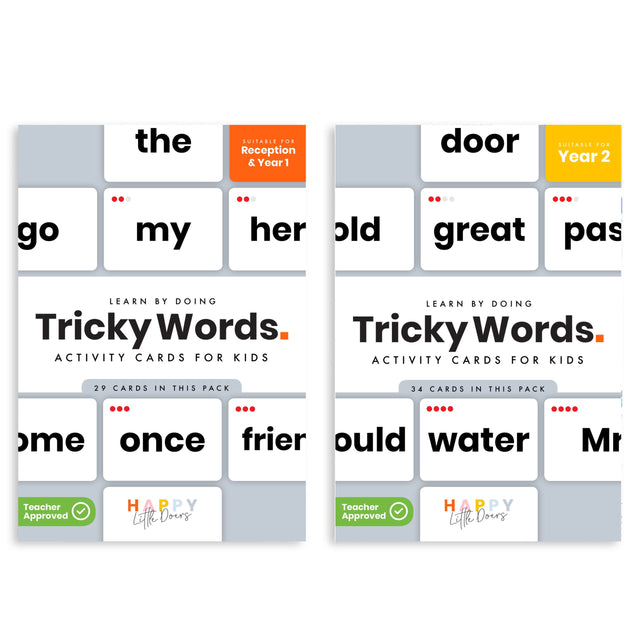


Tricky Words Flashcards - Reception & Year 1
£17.95
FREE SHIPPING ON ORDERS OVER £50

Start typing to see kits, or press Enter to see every match.
Loading…
Parent guide · Tricky words
The short answer
Tricky words, or 'common exception' words, are everyday words like the, said and people that don't sound out the way they're spelt. Children have to learn them by sight.
Reception and Year 1 start with short, everyday words, and Year 2 onwards adds longer ones.

Start here
Most words can be sounded out. Tricky words can't, or not all the way. Sound out s-a-i-d and you get something that rhymes with maid.
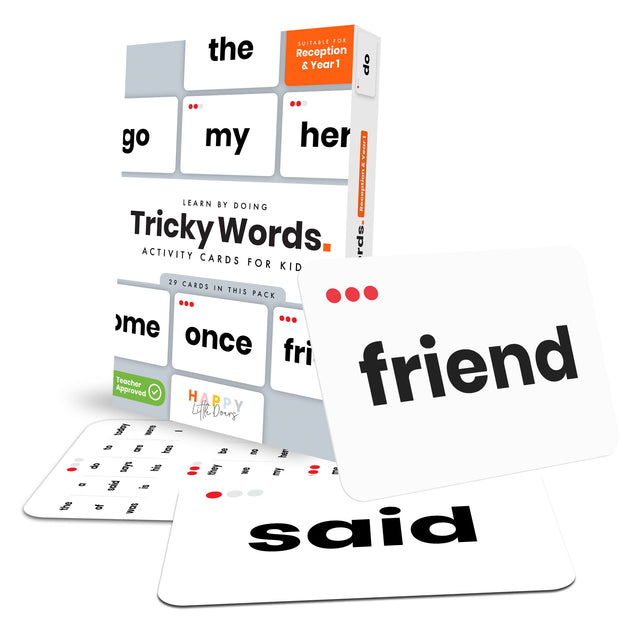
These cards are from our own packs. Turn them over to see both sides.
Tap a card to turn it over.
A closer look Hover over a card, or tap it, to turn it over.
They're the same thing as tricky words. Common exception words is the name the national curriculum uses for the words children learn in Year 1 and Year 2.
You'll hear a few names for them, depending on your child's school and the phonics scheme it follows:
Whatever the name, the word is an exception to the phonics rules your child is learning, so they need to know it on sight.
Some words are only tricky for now. In Reception, he and me are tricky because the e makes a long "ee" sound your child hasn't learnt yet. Once they have, those words can be sounded out after all.
You might also get a list of high-frequency words. That's a different list: it's the words that turn up most often in books, and plenty of them, like and, in and it, sound out just fine.
Year by year
Here's every word, year by year. Schools teach tricky words in an order, but your child's school may use a slightly different list, so it's worth asking their teacher which words they're on.
Short, everyday words. Our Reception & Year 1 pack has these 54, in three groups. That's every Year 1 common exception word in the national curriculum, plus a few everyday tricky words children meet in Reception, like have, like and little.
Longer words, and more of them. These are the 64 Year 2 common exception words, in the four groups our Year 2 pack uses:
The focus moves from reading the words to spelling them. These are the 108 words in our Year 3 & 4 pack, in six groups:
These tricky words cards are great. My daughter loves them and enjoyed going through them to check her knowledge.


HOW TO PRACTISE TRICKY WORDS
Tricky words take a lot of going over, and going over the same words can get old fast. You'll know when they've had enough!
So turn it into a game. Pop a few cards round the house and quiz them as they walk past, or race each other to read a pile. Our packs split the words into small groups marked with red dots, so you only work on a handful at a time.
When a group feels easy, move on to the next, but make sure you revisit the old ones.
Three ways to play (and learn) Tricky Words.
There are lots of fun ways to learn tricky words. See all our games and activities
The best way to learn tricky words is a few at a time, in short games, with plenty of going back over old ones.
Start with the one-dot cards. When your child reads them all without stopping, move on to two dots.
Mix a couple of new words in with ones they already know. Getting most of them right keeps them keen.
Bring back the earlier groups now and then. Seeing a word again and again is what makes it stick.
Three to five new words a week is plenty for most children. Some groups take longer than others, and that's fine: stay on a group until it feels easy. A few minutes most days will do more than one long session at the weekend.


Here's a simple plan for your first month, using the one-dot cards from our Reception & Year 1 pack. It works the same way for any group in any pack.
Week 1
From the one-dot cards, choose five words your child sees a lot, like the, said and was. Show a card, say the word, and let them say it back. Then hide one and see if they can spot which word has gone.
Week 2
Keep last week's five in the pile and add three to five new ones. Stick them on a wall and play Tricky words slam: call out a word and see how fast they can slam it. Any word they stop on stays in the pile for next week.
Week 3
Take the cards off the wall and go hunting. Look for the words in a reading book, on a cereal box or in an old magazine, and let your child circle the ones they find. Add a few more one-dot words as they're ready.
Week 4
Read through every card you've played so far. Words they read straight away go in a "know it" pile, and any they stop on go back in. Keep adding one-dot words until the group's done, then start on two dots, with a few old favourites mixed in.
Lots of schools send a list home, so you may have one already.
School word list
Good for ticking off the words they know. Reading down a list can start to feel like homework, though.
Learning apps
The device takes the lead, which you might want on a long drive or in a waiting room.
Flashcards
For playing together. Cards should be durable, with multiple activities - ready to slam, race and hunt!
THE BENEFITS
Once the tricky words are known by sight, reading starts to flow.

Fewer stops mid-sentence.
Saying the words aloud builds vocabulary.
Seeing the whole word builds the memory to spell it.
Tricky words mastery is a stepping stone to independent reading.
Before you buy
Look for cards that match your child's school year, split the words into small groups, and will stand up to daily use.
Tricky words are taught year by year, so a set should match the words your child is on now. Our packs follow the school lists: Reception & Year 1, Year 2, and Years 3 & 4.
Fifty-odd words is a lot to face at once. Our cards are split into groups of 16 to 18, marked with red dots, so you always know which handful you're on and when to move up.
Each pack comes with game ideas, from word races to word hunts, so you won't run out of ways to play.
Cards get dropped, sat on, carried round in pockets and handled with sticky fingers. So we print ours on thick card, cut them to A6 with rounded corners, and finish them with gloss laminate. Good cards can be passed down to a younger brother or sister.

One pack per school year, or a bundle to grow into.