
Parent guide · Phonics
Phonics at home: how to help your child before and during Reception
The short answer
Phonics is how children are taught to read at school. They learn the sound each letter makes, then blend the sounds together to read a word: s-a-t, sat.
At home, say the sounds the way school does, like sss for s, and keep it to short games.

Start here
What is phonics?
Every word is made of sounds. Phonics teaches your child the sound each letter makes, then how to blend them into words.
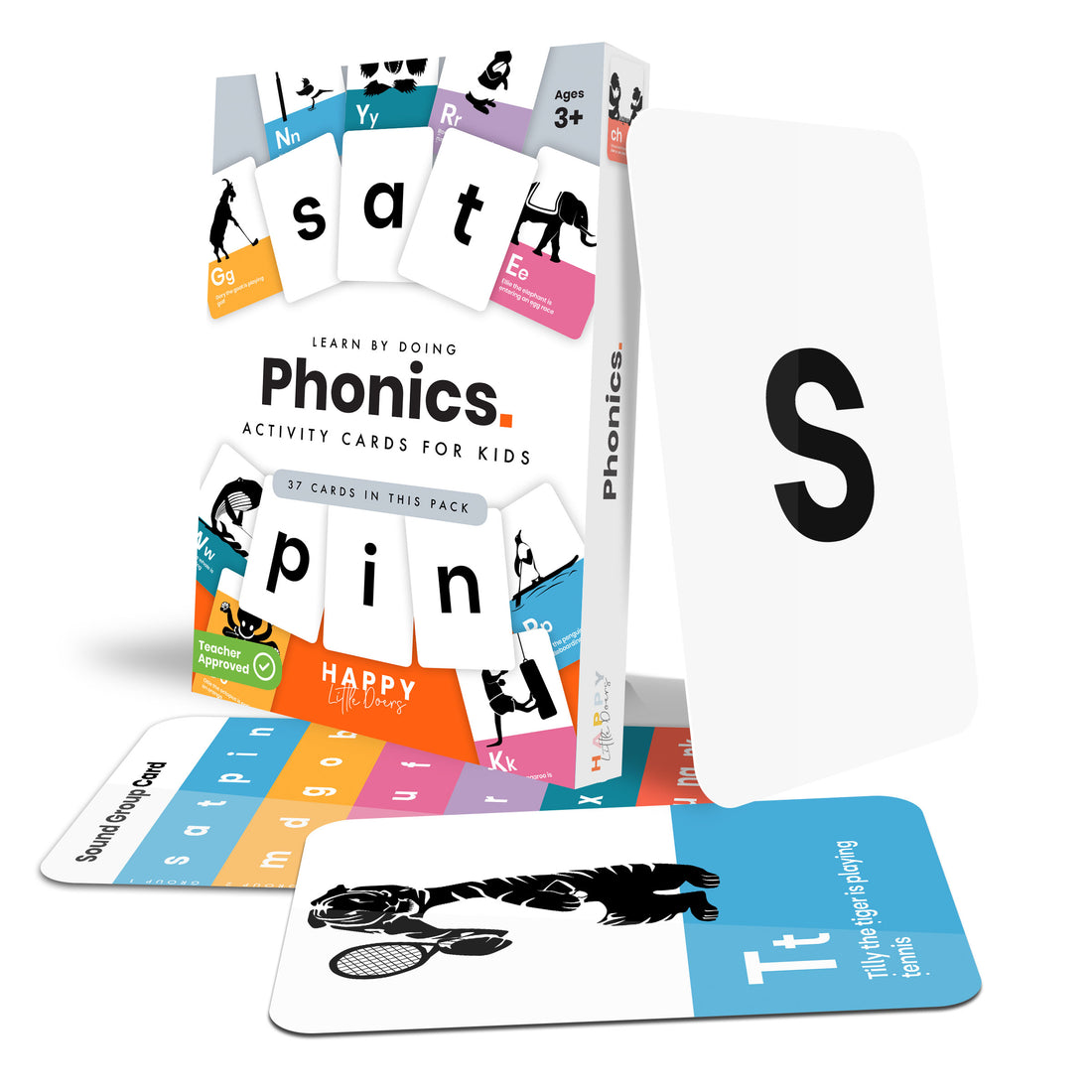
These cards are from our own Phonics pack. Turn them over to see both sides.
Tap a card to turn it over.
A closer look Hover over a card, or tap it, to turn it over.
- Sounds first. Children learn the sound sss before the letter name.
- Then blend them. Sound out s-a-t, say it faster, and it becomes sat.
What order are phonics sounds taught in?
Many schools start with s, a, t, p, i and n. Those six sounds make lots of simple words, like sat, pin and tap, so children can start reading early.
Our pack teaches 32 sounds in six groups, in the order on our Sound Group Card:
- Group 1: s, a, t, p, i, n
- Group 2: m, d, g, o, b
- Group 3: c, k, u, f, e
- Group 4: l, h, r, j, v
- Group 5: y, w, z, x, ck, sh
- Group 6: th, ch, qu, ng, nk
Groups 5 and 6 bring in digraphs: two letters that make one sound, like sh in ship.
Each school follows its own phonics programme, so the order can vary a little. It's worth asking your child's teacher which sounds they're on.
When should you start phonics?
Schools in the UK start teaching phonics in Reception, usually in the first few weeks. You can start a little earlier at home, as long as it feels like play.
Reception: Phonics most days at school. Children learn the single letter sounds and start blending simple words like sat, pin and dog.
Year 1: Two letters that make one sound, like sh, ch and th, then longer words and more tricky words. In June, children read a short list of words aloud to their teacher for the phonics screening check. Some are made-up words, to check they're blending rather than remembering.
They are a great learning aid that can be integrated into play in so many ways to really make learning fun.


Learning through play
How to teach phonics at home
Phonics at school is taught in a set way, and it can feel different from how we learnt. Don't worry, you don't need to know the jargon.
Turn it into a game. Hunt round the house for things that start with sss, or lay out a few cards and ask them to find one. Our games card has more ideas to try.
Phonics games to play at home
Three ways to play (and learn) Phonics.
There are lots of fun ways to learn phonics. See all our games and activities
How to teach phonics to a 4 year old
Keep it light. At four, phonics is mostly about hearing sounds, and you can do that anywhere.
- Play with sounds. Rhymes, songs and I-spy with sounds ("something beginning with sss") all tune their ears.
- Try a few letter sounds. Pick two or three from the first group. Say the sound, let them copy you, then hunt for things that start with it.
- Follow their lead. If they want to blend s-a-t into sat, lovely. If not, there's plenty of time.
Writing words and the trickier sounds can wait for Reception. Their teacher will build on everything you've done at home.
If your child is starting Reception soon, our guide to settling into school covers the first weeks.
Three habits that help
The best way to teach phonics at home is little and often, saying the sounds the way school does.
-
Say the pure sound
Keep each sound short and clean, so mmm rather than muh. Our pronunciation card shows every sound.
-
One group at a time
Stick to one colour group until it feels easy, then add the next. Keep going back to the old ones too.
-
Blend early
Once they know a few sounds, put them together. s-a-t makes sat, and our blending cards have more to try.
How much phonics practice a day?
Five minutes a day is plenty. Stop while they're still enjoying it, and pick up where you left off tomorrow. A few minutes most days does more than one long session at the weekend.


How to use phonics flashcards
Here's a simple five-minute session. It works with any group in our pack.
-
1 minute
Step 1
Start with sounds they know
Warm up with three or four cards they already know. A few quick right answers get every session off to a good start.
-
1 minute
Step 2
Say it, then let them copy
Show a new card and say the sound. Let your child copy you, then turn it over and read the sentence together, stretching the sound: sssebby the sssnake.
-
2 minutes
Step 3
Hide it in the pile
Mix the new card in with the ones they know and play Find the animal: "Can you find the p-p-penguin?" Turn it over to check.
-
1 minute
Step 4
Finish with a word
Put three cards in a row and blend them: s-a-t, sat. Then stop, while they still want more.
Books, apps or flashcards?
School reading books
Keep reading them
They're matched to the sounds your child knows, so they can read them on their own.
Learning apps
Brilliant in the car
The device takes the lead, which you might want on a long drive or in a waiting room.
Flashcards
Made for games
For playing together. Cards should be durable, with multiple activities - ready to hunt, find and blend!
THE BENEFITS
Why does phonics matter?
Once the sounds are secure, children can read words they have never seen before.

Reading new words
Blending lets them work out words on their own.
Clear sounds
Saying each sound aloud helps them hear it.
Writing what they hear
The same sounds help them spell.
Ready for school
Familiar sounds make the first phonics lessons easier.
Before you buy
Choosing the best phonics cards and flashcards
Look for cards that follow the order schools teach, help you say each sound properly, and will stand up to daily use.
Sounds in the order schools teach
A set should follow the order schools teach, a few sounds at a time. Ours come in six colour-coded groups, so you always know which sounds come next.
Help with saying each sound
A pronunciation guide means you say the sounds the way school does. Ours marks short sounds with a dot and long sounds with a dash, like the sound buttons many schools use.
A clue on the back
A picture gives your child a way in. Every one of our letters has an animal acting out the sound, like Tilly the tiger playing tennis, and the games card has five ways to play.
Tough enough for real life
Cards get dropped, sat on, carried round in pockets and handled with sticky fingers. So we print ours on thick card, cut them to A6 with rounded corners, and finish them with gloss laminate. Good cards can be passed down to a younger brother or sister, so you get your money's worth!

The best phonic cards for your child
Everything in this guide, in one pack.
Ready for Reception
Phonics Flashcards
£24.95
- 37 double-sided cards. A letter sound on the front, and an animal acting it out on the back, like Willy the whale waterskiing.
- The 32 sounds children meet first, in six colour-coded groups, starting with s, a, t, p, i and n.
- A pronunciation card, so you can say each sound the way school does, without the jargon.
- Five games on the games card, from Sound hunt to Sand tray play.
STEM.org Authenticated Educational Product