


Learn Times Table Skip Counting Wall Print Poster
£14.95
FREE SHIPPING ON ORDERS OVER £50

Start typing to see kits, or press Enter to see every match.
Loading…
Parent guide · Times tables
The short answer
Repetition, repetition, repetition.
The times tables need to be learnt by rote to sink into long-term memory.
Start with the 2, 5 and 10 times tables: count steps out loud (2, 4, 6, 8, etc.), and cover the tables themselves too (2 x 2 = 4, 2 x 3 = 6, etc.).
A few minutes most days works better than a long session at the weekend. By the end of Year 4, children are expected to know every table up to 12 × 12.
Your school may give you access to an app you can use at home, like Times Tables Rock Stars, and it helps to support this with flashcards to add another dimension.

Start here
Start with the tables that have the clearest patterns (2, 5 and 10).
We recommend a combination of skip counting and writing out the formulas. These cards are from our own Times Tables flashcards. Turn them over to see both sides.
Tap a card to turn it over.
A closer look Hover over a card, or tap it, to turn it over.
Every table children need for the Year 4 check, in one place. Find the table on the left, then read along the row.
| × | 1 | 2 | 3 | 4 | 5 | 6 | 7 | 8 | 9 | 10 | 11 | 12 |
|---|---|---|---|---|---|---|---|---|---|---|---|---|
| 2 | 2 | 4 | 6 | 8 | 10 | 12 | 14 | 16 | 18 | 20 | 22 | 24 |
| 3 | 3 | 6 | 9 | 12 | 15 | 18 | 21 | 24 | 27 | 30 | 33 | 36 |
| 4 | 4 | 8 | 12 | 16 | 20 | 24 | 28 | 32 | 36 | 40 | 44 | 48 |
| 5 | 5 | 10 | 15 | 20 | 25 | 30 | 35 | 40 | 45 | 50 | 55 | 60 |
| 6 | 6 | 12 | 18 | 24 | 30 | 36 | 42 | 48 | 54 | 60 | 66 | 72 |
| 7 | 7 | 14 | 21 | 28 | 35 | 42 | 49 | 56 | 63 | 70 | 77 | 84 |
| 8 | 8 | 16 | 24 | 32 | 40 | 48 | 56 | 64 | 72 | 80 | 88 | 96 |
| 9 | 9 | 18 | 27 | 36 | 45 | 54 | 63 | 72 | 81 | 90 | 99 | 108 |
| 10 | 10 | 20 | 30 | 40 | 50 | 60 | 70 | 80 | 90 | 100 | 110 | 120 |
| 11 | 11 | 22 | 33 | 44 | 55 | 66 | 77 | 88 | 99 | 110 | 121 | 132 |
| 12 | 12 | 24 | 36 | 48 | 60 | 72 | 84 | 96 | 108 | 120 | 132 | 144 |
The highlighted squares are the square numbers, like 7 × 7 = 49. Every other answer appears twice, because 3 × 8 is the same as 8 × 3.
Year 2 to Year 4
In June of Year 4, children in the UK take the Multiplication Tables Check. It's a short test on a screen, with 25 questions from the 2 to 12 times tables and 6 seconds to answer each one. There's no pass mark.
Year 2: The 2, 5 and 10 times tables, plus counting in 2s, 5s and 10s.
Year 3: The 3, 4 and 8 times tables.
Year 4: Every table up to 12 × 12, and quick recall in time for the check in June.
Six seconds isn't long enough to count up, so the check is really about knowing the answers. Short, regular practice is what gets them there.
Perfect to help my little girls revise & recap her tables. Beautiful colour scheme!

The check is about speed, so the aim is answers they just know, rather than answers they can work out.
Most of all, keep it light. There's no pass mark, and a relaxed child remembers more.

Learning through play
Times tables stick through repetition, so a few minutes most days does more than an hour on a Sunday.
Count up it out loud together, then count back down. Once that's easy, mix up the questions and see how quickly they can answer.
Keep going over the tables they already know, too. A quick 2s or 5s warm-up gets them off to a confident start.
Three ways to play (and learn) the times tables without an app.
There are lots of fun ways to practise times tables. See all our games and activities
The best way to learn times tables is out loud, a little at a time, and checking as you go.
Chanting "3, 6, 9, 12" in the car or on the walk to school all counts.
If they know 3 × 7, they know 7 × 3. Every table they learn makes the next one smaller.
With flashcards, write the answers, flip the card to check, and wipe off the ones to try again.
It varies, and that's normal. With regular practice, many children feel confident with a new table in a few weeks. The 2s, 5s and 10s usually come quickest, and the 7s and 8s take longest.


These are the tables children most often get stuck on. A trick for each one can help.
Apps
Handy for quick-fire questions once they know most of the tables.
Wall posters
A poster on the bedroom wall means they see the tables every day.
Flashcards
One table at a time. Count round it, write the answers, flip to check and wipe clean!
A poster works quietly in the background. Seeing the tables every day helps them sink in a little at a time.
Put it where your child will see it often: next to their bed, by the desk, or even on the back of the toilet door. Ask a question now and then, like "What's 4 × 8? Check on the poster."
Posters are best for seeing the patterns, and cards are best for practising. Our A3 times tables grid print and skip-counting print come in seven colourways, so they suit the room as well as the maths. Or why not get a matching pair?
THE BENEFITS
Once the tables are quick, lots of other maths gets easier.

If they know 4 × 5 = 20, they know 20 ÷ 5 = 4.
Finding a quarter of 12 is the 4 times table in disguise.
Doubling, halving and spotting what comes next.
Quick answers leave more room for the tricky part of a question.
Before you buy
Look for cards that follow the order schools teach, show each table more than one way, and give room to practise.
A card for each table means you can work on the 5s without the 7s getting in the way, and move on in the order schools teach.
Some children learn a table by counting it, and some by seeing it written out. Ours have a skip-counting card and a full table for every number from 1 to 12.
Wipe-clean cards let them write the answers, check, and go again, as many times as they need.
Times tables cards get written on, wiped and shuffled again and again. So we print ours on thick card, cut them to A6 with rounded corners, and finish them with gloss laminate. Good cards can be passed down to a younger brother or sister, so you get your money's worth!

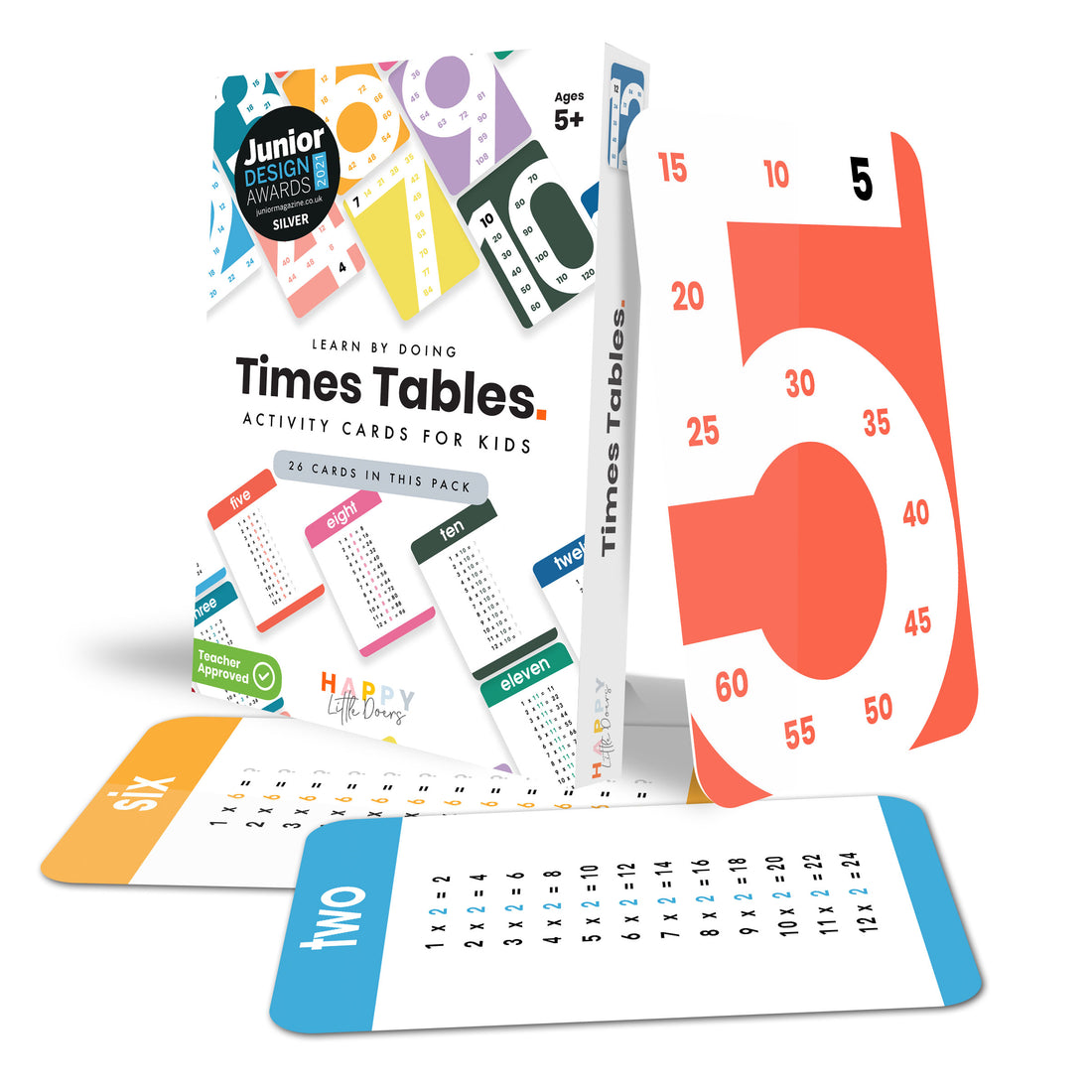
Award-winning
£17.95
Junior Design Awards 2021 · Silver · Best Educational Toy/Game


