

Numbers Flashcards
£17.95
FREE SHIPPING ON ORDERS OVER £50

Start typing to see kits, or press Enter to see every match.
Loading…
Parent guide · Numbers
The short answer
We all know maths is an essential skill for life. So how do you build confidence with numbers?
It starts with counting, then first sums. And once numbers feel familiar, the bigger sums come.
Numbers make more sense when children can see and touch them. Start with real things to count, then link each amount to its number and its name.
Once they're secure to 10, move on to number bonds (e.g. pairs that make 10), then the teens, then tens and ones up to 100.

Flashcards
Flashcards can lend a helping hand as they make numbers feel less abstract.
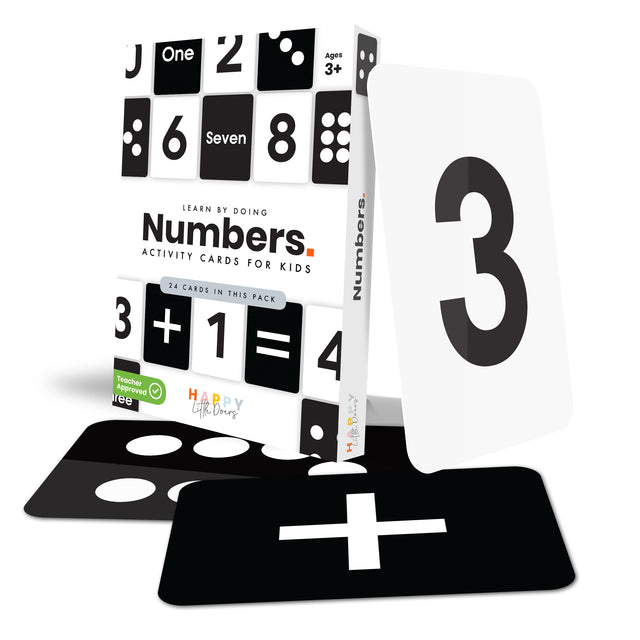
Every number comes in three formats (e.g. '4', 'four' and a count of four), so it's important that children build that association. Roll over to see what we mean:
Tap a card to turn it over.
A closer look Hover over a card, or tap it, to turn it over.
Number bonds are pairs of numbers that make a total. 6 and 4 make 10, and so do 8 and 2.
Children usually start with bonds to 5 and 10 in Reception, then bonds to 20 in Year 1. Schools spend a lot of time on them because they're the building blocks for bigger sums: if 6 and 4 make 10, then 60 and 40 make 100.
Once they know them, bonds make tricky sums easier. 8 + 5 becomes 8 + 2 + 3: up to 10, then 3 more.
Every child moves at their own pace, so use this as a rough guide rather than a checklist.
Toddlers (2 to 3): Counting songs, saying numbers in order, and "how many?" with two or three things.
Pre-school (3 to 4): Counting objects to 5, then 10. Spotting numerals they know, and saying which group has more.
Reception (4 to 5): Really knowing the numbers to 10, and seeing up to 5 at a glance without counting. Number bonds to 5, and counting beyond 20.
Year 1 (5 to 6): Counting to 100, number bonds within 20, and adding and taking away small numbers.
Year 2 (6 to 7): Tens and ones up to 100, quick recall of bonds to 20, and the 2, 5 and 10 times tables.
Our son has never been very interested in his numbers… He is now obsessed! This morning he even chose to play ‘Speedy Numbers’ before breakfast instead of watching his tv show, a real first!


Learning through play
Numbers make more sense when children can see, touch and move them.
Count real things first: stairs, grapes, toys on the dots. Then put a number card next to them, so they link the amount to the numeral.
Ask "how many more?" and "how many left?" as you go. Five strawberries, eat one, how many now?
Three ways to play (and learn) with numbers.
There are lots of fun ways to play with numbers. See all our games and activities
The best way to teach numbers 1 to 10 is with things they can touch and move, a few minutes at a time.
Touch each one as you count. It stops them skipping or counting twice.
Snap, matching and "which number is missing?" all count as maths.
"How did you work that out?" helps them explain, and helps you see what they know.
Not much, and it doesn't have to be at a table. Counting the buttons on their coat or the ducks at the park all counts. A few minutes most days soon adds up.


Worksheets
Handy once they know how a sum works and want to practise writing it down.
Apps
Useful for a car journey or a waiting room.
Flashcards
Numbers, words and dots to count, match and snap, plus symbol cards for first sums!
A number poster gives your child something to look at every day, and something to point to when you're playing.
Then use it in a game: "Can you find the number that comes after 7?"
THE BENEFITS
A good feel for numbers makes the rest of maths easier.

If they know 7 and 3 make 10, they know 10 take away 3 is 7.
The teens are the first step towards numbers up to 100.
Odds and evens, counting in 2s and doubling.
Numbers they understand feel less like a test.
Numbers are part of almost everything a child does, long before they meet them at school.
How many sleeps until their birthday. Sharing out sweets so it's fair. Finding the right bus, the right house number or the right page in a book. Setting the table with a fork for everyone.
Talking about numbers as they come up shows your child what numbers are for. It also means maths at school builds on something they already know, which makes it feel a lot less like a test.
Before you buy
Look for cards that link each number to an amount, grow with your child, and can turn into first sums.
A good set links the numeral to its name and to an amount they can count. Ours show all three.
Cards that go past 10 keep up as your child does. Our Extension pack takes them from 10 to 20.
Plus, minus and equals cards turn the same set into sums, so the cards stay useful from first counting to Year 1.
Number cards get counted, matched, slapped in snap and shuffled again. So we print ours on thick card, cut them to A6 with rounded corners, and finish them with gloss laminate. Good cards can be passed down to a younger brother or sister, so you get your money's worth!