
Parent guide · Babies
Black and white cards for babies: when, why and how to use them
The short answer
Newborns see best up close and in strong contrast, so bold black-and-white patterns give them something to focus on from the first weeks.
Hold one card 20–30 cm from their face for a few seconds at a time, and follow their lead.

Start here
Why black and white cards for newborns?
In the first few weeks a newborn's eyesight is still blurry, and they see best close up. Strong contrast, like black next to white, is the easiest thing for them to pick out.
These cards are from our own Sensory pack. Turn them over to see both sides.
Tap a card to turn it over.
A closer look Hover over a card, or tap it, to turn it over.
- Close up. Newborns focus best at about 20–30 cm, roughly the distance to your face during a feed.
- Bold and simple. Big circles, stripes and checks, with nothing fussy.
- A splash of red. It's the next thing they'll notice, a few weeks in.
What are sensory flashcards for babies?
Sensory cards, high-contrast cards and black-and-white cards are all names for the same thing: simple, bold cards made for a baby's eyes in the first months.
They're called sensory cards because they're made for looking at, rather than learning from. There are no letters or numbers to get through, just shapes and patterns your baby can find and follow.
Many are double-sided, with simple pictures on the back to grow into. You'll also see them sold as infant flash cards, or flash cards for newborns.
What age are black and white cards for?
From the first few weeks. What changes is how you use them, as your baby's eyesight grows.
Baby flash cards 0-6 months: what to show when
0–4 weeks: Simple, bold patterns, held close. Circles, stripes and checks work best.
1–2 months: Bring in the cards with a splash of red, like the apples on the tree or the flag on the boat.
2–4 months: Tummy time. Stand a card up a little further away, as they start to see further.
4–6 months: Turn the cards over to the animals, and name them as you go, noises and all.
Once they're reaching, pointing and babbling, colours and first words come next. Our On the Farm pack has animals, colours and a first memory game, and our guide to flashcards for toddlers picks up from there.
Every baby moves at their own pace, so go by what holds their attention rather than their age in weeks.


Learning through play
How to use black and white flash cards with your baby
Newborns tire quickly, and that's completely normal.
There's no right or wrong way to do it. Hold a card close, talk about what you can see, and move on to the next when their eyes drift away.
Things to do with baby flashcards
Three ways to play (and learn) with black-and-white cards.
There are lots of fun ways to play with baby cards. See all our games and activities
Three habits for using newborn flashcards
The best way to use black-and-white cards is one at a time, close up, and only while your baby is enjoying it.
-
One card at a time
Show one card, then swap. A whole spread is a lot for new eyes to take in.
-
Talk as you go
Name what's on the card and make the sounds. Your voice is their favourite thing to listen to.
-
Follow their lead
If they look away, yawn or get fussy, they've had enough. Try again later.
How long should each session be?
A minute or two is plenty for a newborn, and a few minutes once they're a little older. Little and often works best: a card at nappy changes, another at tummy time.


THE BENEFITS
Black and white flash cards for newborns: what do they do?
A few quiet minutes together gives your baby plenty to look at.

Eyes that settle and follow
Something clear to look at, and then to follow.
A reason to lift their head
Something to look at makes tummy time easier.
Time together
Face to face, talking as you go.
First sounds
Naming animals and copying their sounds.
Black and white images for baby brain development: do they help?
They give your baby plenty of practice at looking, which is how their eyesight develops. There's no good evidence that they make a baby cleverer or speed up development.
Here's what the evidence does support:
- Babies prefer patterns. Since the 1960s, studies by the psychologist Robert Fantz and others have shown that even newborns look longer at bold patterns than at plain shapes.
- Contrast is easiest to see. Black against white is the strongest contrast there is, so it's the first thing young eyes can pick out clearly.
- Looking grows with practice. Newborns can follow a face in the centre of their view, and by 6 to 8 weeks most will turn their head to follow a moving object, according to the NHS Healthier Together guide to vision.
So think of the cards as something interesting to look at together. For an infant, your face, your voice and time with you matter more than any card.
Before you buy
What to look for in black and white baby flash cards
Look for bold, simple designs, cards you can turn over as your baby grows, and a size that's easy to hold close.
Bold and simple
Big shapes and strong contrast, with no fussy detail. A baby can't pick out small patterns yet, so less is more.
Something on both sides
Double-sided cards give you a pattern to start with and a picture to turn to as your baby grows, so one set lasts for months.
The right size
Small enough to hold close to your baby's face, and big enough for the pattern to fill their view. A6 works well.
Made to be handled
Baby cards get grabbed, dropped and waved about. Ours have rounded corners, are uncoated and plastic-free, and are ready to pass on to the next baby.

The best black and white flash cards for babies
High-contrast cards for the first weeks and months.
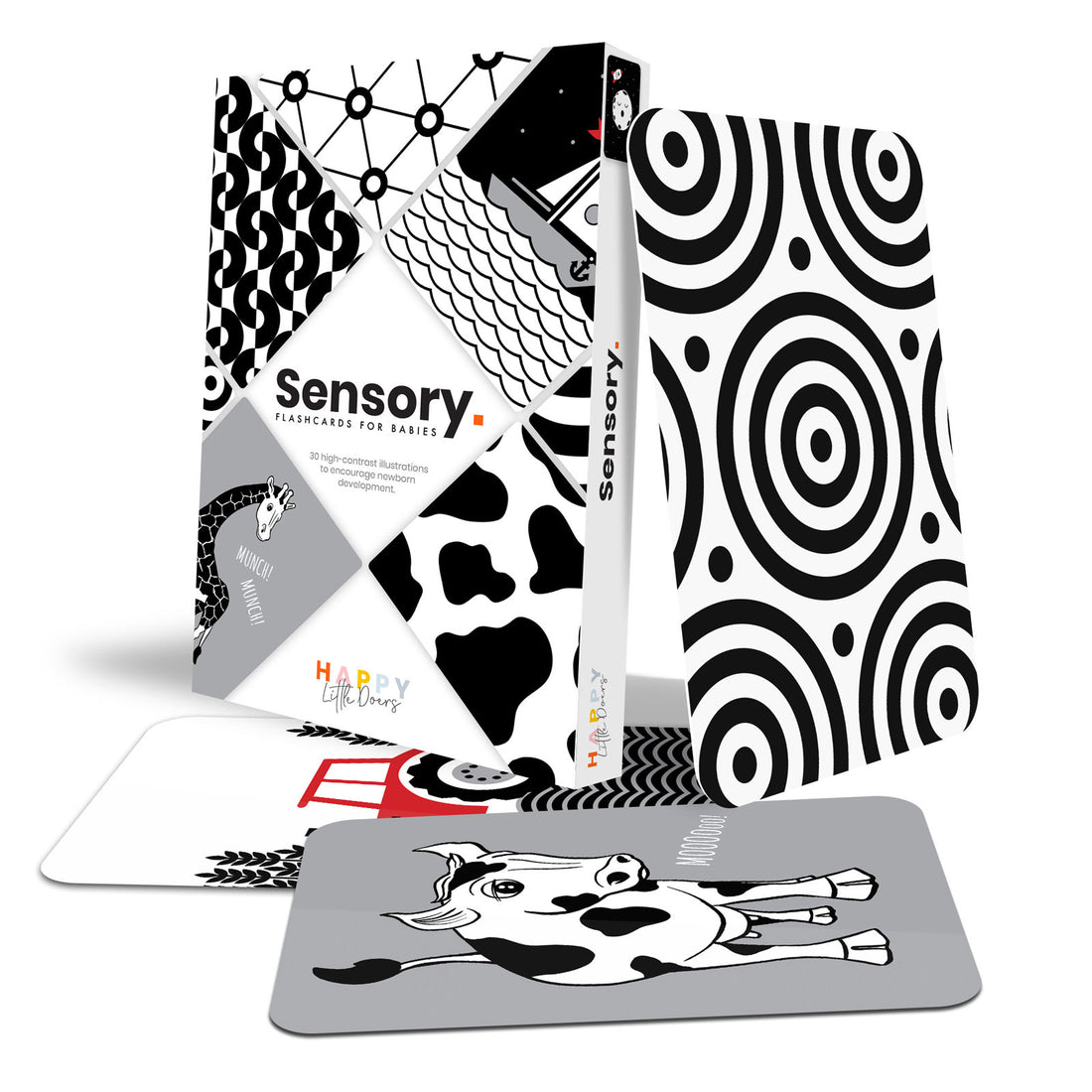
From day one
Sensory Flashcards for Babies
£14.95
- 15 double-sided cards, 30 designs. Bold patterns on one side, and animals and nature on the other.
- Black and white, then red. The cards follow the order a baby's eyesight develops.
- An activity card that guides you through each newborn stage, from close-up focus to tummy time.
- A6, with rounded corners, uncoated and plastic-free.
STEM.org Authenticated Educational Product